hopstone✦
Strategy guide
Why one long chain beats many short ones
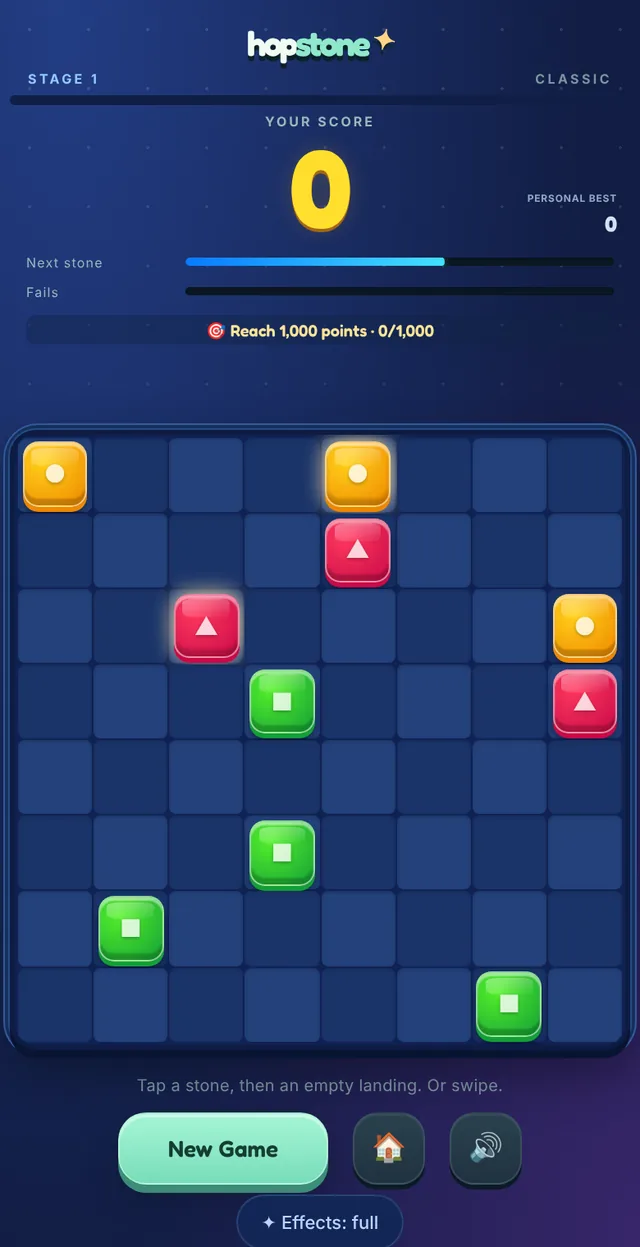
Hopstone is played on an 8 × 8 board, and almost every decision comes down to one question: how long can this chain get? The reason is the scoring curve. Each hop in a chain is worth more than the one before it, and the steps keep growing.
| Hop in the chain | Points for this hop | Chain total so far |
|---|---|---|
| 1st | 10 | 10 |
| 2nd | 30 | 40 |
| 3rd | 60 | 100 |
| 4th | 100 | 200 |
| 5th | 150 | 350 |
| 6th | 210 | 560 |
| 7th | 280 | 840 |
| 8th | 360 | 1,200 |
Five separate one-hop turns earn 50 points. The same five hops played as one chain earn 350 – seven times as much. An eight-hop chain is worth more than a hundred single hops. That is the whole game in one table: removing stones is easy, removing them in one go is the skill.
The same-color bonus
When your stone jumps over a stone of its own color, that hop is scored as if it were one step further along the chain. A same-color first hop pays 30 instead of 10; a same-color fourth hop pays 150 instead of 100.
The bonus applies to that single hop – it does not push the rest of the chain up. That makes it most valuable late in a chain, where the steps are biggest. If you can choose the order of your hops, try to take the mixed-color stones first and the same-color ones last.
The 🌈 Rainbow stone makes all new stones arrive in one color for 10 seconds. Trigger it when the board has room, then cash in on same-color hops.
Reading the board
Trace the route before you tap
Your stone stays selected after every hop, so a chain is really a path. Before you start, follow it with your eyes: where does the stone land, and what is next to it from there? A hop that looks good on its own can strand your stone in an empty area and end the chain early.
Corners and edges
A jump needs a free field directly behind the stone you jump over. A stone in a corner has no field behind it in any direction, so it can never be removed by jumping. Stones on an edge can only be jumped along that edge. Stones that sit there take up space for the rest of the run.
The fix is to use them as the jumping stone. Start a chain with the corner stone and it leaves the corner by itself.
Keep the middle busy
Stones in the middle of the board can be jumped from eight directions and can jump in eight directions. A loose cluster in the center – stones with single gaps between them – is the raw material of long chains. A tightly packed block is not: a jump needs an empty landing field, and a packed block has none.
Think in landing fields
Beginners look at stones. Experienced players look at the empty fields, because every hop needs one. If a great chain is missing exactly one landing field, check whether a short earlier hop could open it.
Don't break the chain
If your stone could still jump and you select a different stone instead, the chain is broken. The turn scores 0 points and the Fails bar goes up. When that bar is full, the next five arrivals each bring one extra stone.
Two habits keep the bar empty:
- Finish what you start. If the stone can still hop, take the hop – even a weak one is better than a broken chain.
- Plan the ending. The cleanest chains end on a field where no further jump is possible. Then you can switch stones freely.
Managing the arrivals
The Next stone bar is the clock of Time Attack. When it is full, new stones land on the board, and when the board is full the run is over. The pace picks up as the run goes on.
- Half-full is ideal. A nearly empty board gives you no chains. A nearly full one gives you no landing fields. Aim for the middle.
- Waiting is a move. With plenty of space, letting one more arrival land can turn a three-hop chain into a six-hop chain. With little space, take what you have.
- The ⏳ Hourglass buys time. It stops arrivals for 10 seconds, including penalty stones. Use that window to clean up, not to wait.
- The ☀ Golden stone is your reset. It appears at high scores and clears the board when you jump over it. If the board is filling up, make reaching it the priority.
Special stones inside a chain
Special stones do not move, but jumping over them counts as a normal hop – and triggers their effect in the middle of your chain. That is where they are strongest.
- 🧱 Builder puts a new stone next to you. In the best case it is exactly the stone your chain was missing.
- 💣 Bomb removes a nearby stone or blocker. Gray blockers cannot be jumped, so a bomb is the only way to get rid of them.
- ⭐ Star adds 40 points. It is a small bonus – never give up a longer chain for it.
Stages and what they unlock
Your score moves you up through the stages. Each step takes more points than the one before.
| Stage | Starts at | New on the board |
|---|---|---|
| 2 | 500 | ⭐ Stars and gray blockers |
| 3 | 1,500 | 💣 Bomb and 🧱 Builder |
| 4 | 3,000 | ⏳ Hourglass and 🌈 Rainbow |
| 5 | 5,000 | – |
| 6 | 7,500 | – |
| 7 | 10,500 | Award: “Reached Stage 7” |
Bonus Rush and Mega Clear
⚡ Bonus Rush
A chain of seven or more hops can unlock a Bonus Rush: a hand-made board with exactly one route of 12 hops, and every hop scores double. You have 10 seconds to find the start and then 5 seconds per hop.
Use the first seconds to look, not to tap. There is only one full route, so a wrong first hop cannot be repaired – trace the path before you start.
Mega Clear
Leave a single stone on the board and you get +750 points and a fresh board. It is rarely worth forcing, but when only a handful of stones are left, check whether one chain can take them all.
Milestones to chase
Hopstone keeps a list of awards on your device. They make good personal goals:
- Score: 1,000 · 10,000 · 20,000 · 50,000 · 100,000 points in one run.
- Chain length: 4, 7, 8, 9, 10, 12, 15 and 20 hops in a single chain.
- Firsts: first CASCADE, first Clear, first Mega Clear, reaching stage 7.
New to the game? Read the rules first. Prefer puzzles without a clock? The Adventure guide covers the 50 puzzle levels.